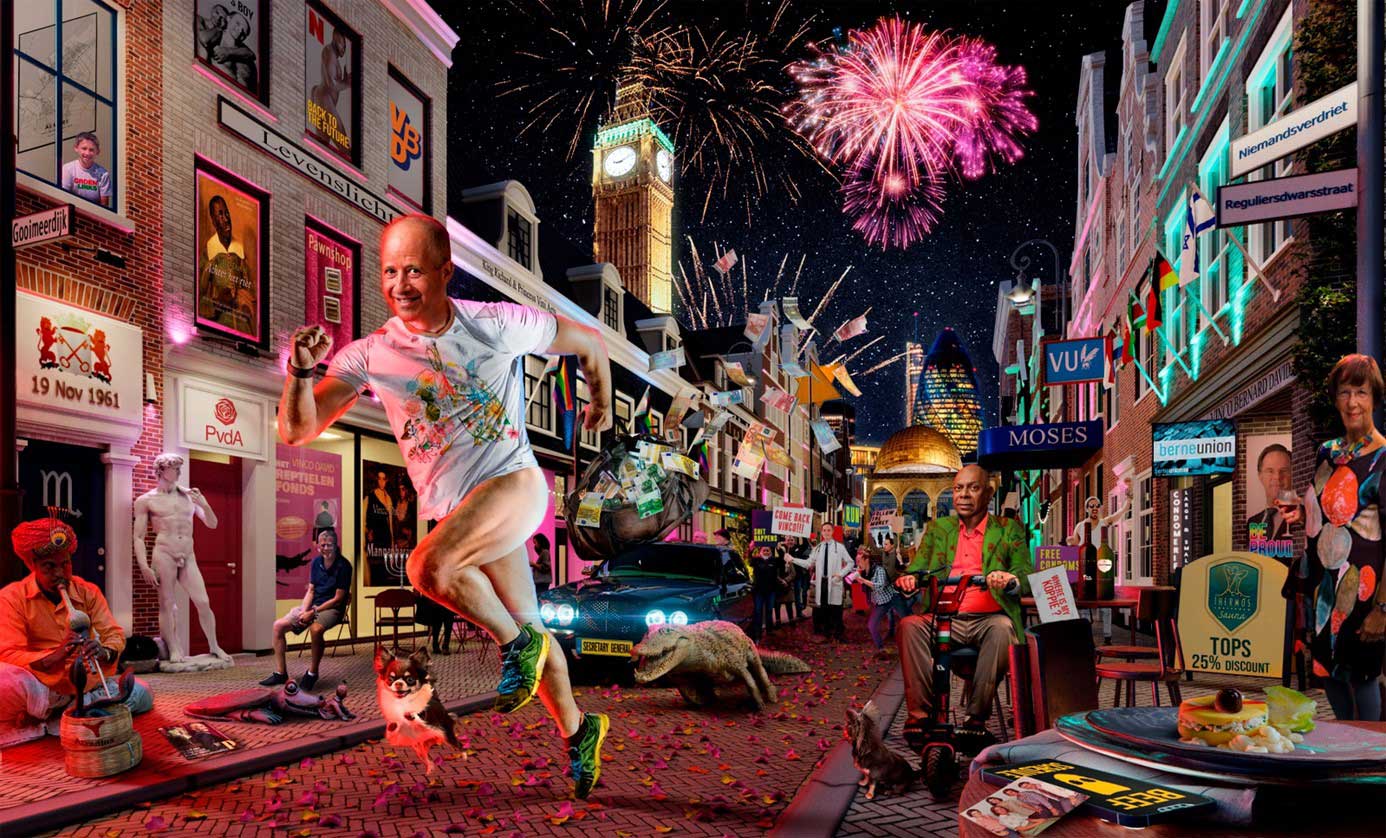
Nehru made India stand up, Manmohansingh made India walk, Modi makes India run!
Interview with Dutch futurists Adjiedj Bakas and Vinco David about their first Indian book #Forwardism
The Dutch Embassy in Delhi is buzzing with excitement. On 01 July, futuristic-trend book #Fowardism is launched, the first Indian book from the famous Dutch authors and thinkers.
Adjiedj Bakas is of Indian origin. His family migrated to Suriname (formerly Dutch Guyana) in the Caribbean from Bareilly UP in the 1890s.
Vinco David is of Jewish origin. He graduated as a political scientist and became responsible for insuring 13 per cent of annual global trade, a staggering US $ 2,5 trillion.
Who is Adjiedj Bakas?
I was born and raised in the multicultural Caribbean amongst people of Indian, African, Chinese, European, Jewish and Indonesian origin. A lovely and exciting melting pot. The rich kitchen in this former Dutch colony is a blend of tastes and flavours from all those population groups. Most Indians don’t know about the Indian diaspora in the Caribbean, yet millions of people there have Indian roots. The author V.S. Naipaul was one of the most famous Caribbean Indians. I admire him and his work. I don’t have his talent for writing novels, though. So I specialize in futuristic books.
How can the current megatrends reshape our lives? That’s a question that has fascinated me since I was a teenager. Aged 18, I migrated to the Netherlands, then graduated from a Dutch university a few years later before starting work in Dutch television. I was lucky to meet the greatest Dutch minds – futurists, future-oriented politicians, business leaders – who more or less adopted me, embraced me, nurtured my talents. I was warmly welcomed in the Netherlands. I’m a happy Dutchman, with some curry in his veins. And I’m a happy Caribbean Latino too.
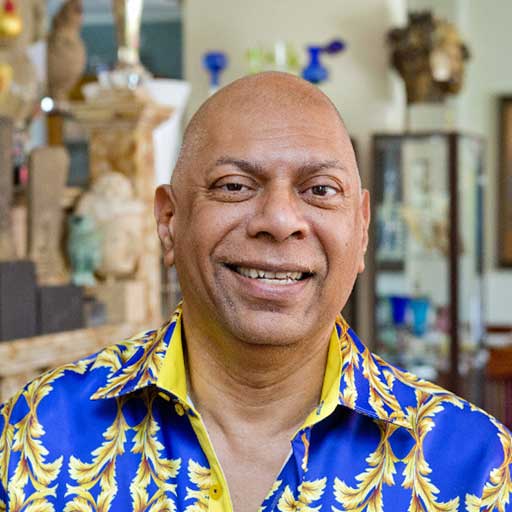
How Indian do you feel?
Having lived outside India for more than 130 years, my family and I are thoroughly de-Indianized, Dutchified and Latinized. So I have a hybrid, portable identity: a blend, a hodgepodge. When I’m here in India, where everyone looks the same as me, it feels great. The colours, the smells, the great ancient architecture, the deep-felt spirituality of the country – it all touches me.
But I’m aware that I stand with only one leg only in this society. It amazes me that people care so much about what others think of them here. Why? Live life happily, just for yourself. It’ll be over before you know it. For me, it’s also funny to see how much Indians care about skin colour. The darker you are, the more Dutch people love you. I live in the Netherlands, so am very popular amongst gay and bi men. They flirt with me all the time, trying to seduce me. So I often sunbathe to keep my market-value high. And here in India every family wants an arranged marriage for their kids, with someone of lighter skin. Ha-ha. Go to the beach, folks, get a tan, the sun is good for you and your skin!
Did you achieve all that you wanted as a young boy?
When I was 10, I dreamt of traveling the world, marrying a lovely man, living in a grand house, having dogs, driving a grand British car, a Bentley or whatever. I dreamt of being seen and heard. It all turned into reality. But at a price. I’ve survived two brain haemorrhages, cancer and a spinal cord injury. So the left side of my body is paralyzed. But I have 80 per cent of my previous pre-illness life back, so I am thankful. My brain works fine again, and those setbacks taught me who my real friends are. I’m lucky to have them. They support me, love me, comfort me, make me laugh and humour me. I met my first husband when I was 21. For 8 years we were happy. He died of cancer. With Vinco, my second husband, I’ve been happy for 25 years. But he now has cancer too and may not live long. So I’ll be a widower again, for the second time. But I’m thankful to have loved and been loved for 8+25=33 years. Many people have never been loved once in their lives. So I thank God for this wealth.
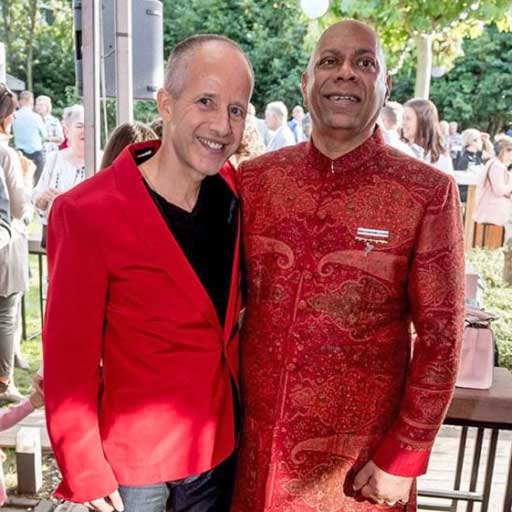
Who is Vinco David?
I’m Dutch. I graduated as a political scientist in Amsterdam, specializing in geopolitics. Since I was a young boy I’ve been passionate about studying atlases and how geopolitics changed (and still are changing) the world. I own a large collection of antique atlases and they always enable me to fantasize about past times, current times and the future of the world.
After graduating from the Vrije Universiteit (Free University) in Amsterdam, I first worked for the Dutch Ministry of Finance, then later joined Atradius, one of the world’s main credit insurance multinationals. There I became responsible for insuring world trade. At the height of my career I was responsible for insuring 13 per cent of annual global trade, a staggering US $ 2,5 trillion. I retired in 2022. I’m happily married to the love of my life: my Indo-Caribbean husband, futurist Adjiedj Bakas, with whom I’ve been happily married for 25 years.
Being openly gay never damaged my career opportunities. I rose to great heights, together with Adjiedj, who was always by my side, even during meetings and dinners with high ranking officials – ministers, CEO’s of other multinationals and royalty. I’m of Jewish origin and he is Indian. In the nineteenth century, his family migrated from India to the Caribbean, where he was born and raised. We both travelled a lot, all over the world. I fell in love with Indians and their culture, both in India and in the Indian diaspora in the Caribbean. I love Indian food and Indian culture. I was also involved in insuring China’s New Silk Roads, which will connect EurAsia and EurAfrica.
I’m a child of a country in the Global North, and all books, essays and op-eds that I’ve written were aimed at an audience in the Global North: affluent, highly developed, yet also ageing and at the peak of its susceptibility to decadence, loneliness, anxiety and fear for the future.
Who are Adjiedj and Vinco together?
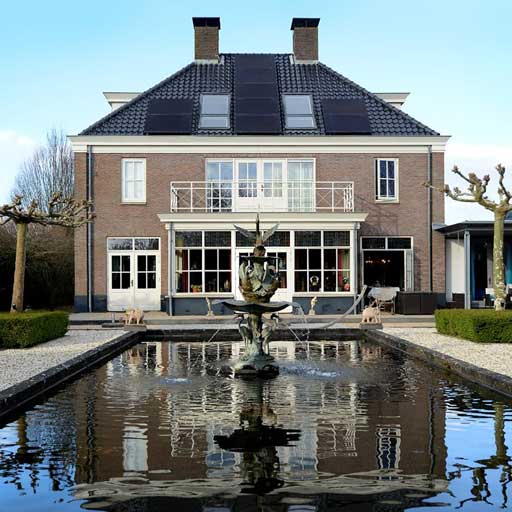
We’ve been a happy married, powerful couple for 25 years. We’re each other’s lover, best friend and soulmate. We’ve travelled the world extensively and live with our doggy Laika and our carer Anna in our villa called Haveli Ahava (the House of Love) in Almere, a garden city in the Amsterdam Metropolitan Region. We’re golden boys, despite both having been struck with severe diseases. It’s a pity that one of us is dying now, but we believe death is a comma rather than a full stop. We expect to stay in touch afterwards.
Why did you decide to write the book #Forwardism?
In 2010 we already had the idea to write a book about how the megatrends could shape a New World Order, tremendously changing the underdeveloped countries in the Global South. Travelling in countries with an overwhelmingly young population, such as India, Indonesia and Nigeria, we are touched by the energy of the youth. They’re fiercely energetic, ambitious and want to free themselves of the shackles of the past: the shackles of incompetent leadership, tribalism, corruption and nepotism. They are movers and shakers, embracing modern technology, globalisation, IT and AI. We’re very happy that many countries in the Global South are becoming more affluent, that the middle classes are emerging and growing fast. Yet much more is possible in order to achieve faster economic growth.
In our book #Forwardism we write about how youngsters in the Global South can achieve more within a shorter amount of time. The huge demographic dividend of the Global South is a massive benefit. For example, many beautiful ancient villages in southern Europe are now depopulated due to ageing and urbanisation. There are lots of job opportunities for young Indians there, especially in tourism and healthcare. Young Indians should stop migrating illegally to the US, from where Donald Trump deports them. They should look to Europe instead, where there is a need for younger people. Without hiring expensive human smugglers, Indians can easily and legally migrate to Europe. In Italy, Spain or Portugal, young Indians can buy empty houses or even whole empty villages for just $1! Of course, after being uninhabited for many years they need renovation. But if you are handy, you can learn DIY on YouTube, become a carpenter, mason, plumber, electrician or painter. With a group of friends you can do it cheaply. Then, when you own a home, you can start working in tourism, healthcare or another industry. You can save money by growing your own vegetables, for example, in a small greenhouse in the garden. Thousands of young Indians and Nepalese are already doing this. But get your papers, certificates and driving license back home first before you opt for this.

Do you advocate for all young Indians to migrate to an ageing Europe, to repopulate the continent?
Of course not. But just look at the facts. India’s population is now 1.4 billion. The current median age is 27 years, meaning that half the population is older than that, and the other half younger. Youth unemployment is already very high. Even youngsters with a university degree can’t find a suitable job, and have to settle for low-skilled work, a waste of their IQ, talent and education. In 2050, the Indian population is expected to peak at 1.7 billion, from where it is expected to start declining. The Indian economy is growing fast but will be unable to generate enough jobs for the youngsters. So grab your job opportunities now, whether within or outside India!
In the book you launch more bold ideas. You write that if Trump can buy Greenland, India can buy half of Afghanistan from the Taliban?
Yes, but without its people of course, to repopulate with young Indians. India can then gain an overland corridor into Central Asia and the network of New Silk Roads that China is building, connecting EurAsia and EurAfrica. Don’t forget: China is ageing fast too; as is Russia. At the end of this century the population of both China and Russia will be halved. But the New Silk Roads will still be there, and will prove beneficial to Indian businesses and young Indians. Afghanistan is dirt poor, and the Taliban need money. India is rich and can afford to buy land.
In the book you also advocate that India buys islands in several oceans, near places where a lot of raw materials can be mined?
Yes. China is already boldly doing that. India can do the same. Deep sea mining is the future. Mother Earth is very generous to us humans. Under the seabed, enormous amounts of rare earths, uranium, thorium, lithium and suchlike are waiting to be mined.
In the book you write that Indian’s are currently too modest and do not have the superpower mindset?
Indians are known as people who don’t rock the boat. They are modest people. Get up and change is not their mentality. But the Chinese do have that mentality, and it makes them move forwards fast. The Indian mentality is perhaps a remnant of the caste system, which kept people in their place. In combination with the infamous Indian bureaucratic rot, this is not the winning spirit that is needed if India truly wants to become a future superpower. So, India should invest in changing its mindset soon. Then India’s economy can evolve into the Happynomy, the Economy of Happiness. We believe ambition is a good thing.
Why do you believe in ambition as a virtue?
Because we are examples of ambition’s great results.
Vinco: My Jewish family was wiped out during World War II, and the impoverished survivors, including my parents, had to start afresh afterwards. A Holocaust survivor, a gay boy and a short man growing up in a country populated by the tallest men in the world, I had to fight hard for a good life. In the Netherlands, shorter men have to work harder to achieve the same success as taller men – the short man syndrome. I succeeded. I made a wonderful career and found Adjiedj, the love of my life. My ambition and perfectionism helped me immensely.
Despite all that my parents experienced during the horrors of World War II, I learnt not to be afraid of anyone and anything. My husband came to the Netherlands from the Caribbean with only the clothes he was wearing. Nothing else. No money, no assets, no gold. Yet due to his talents and ambition, he is part of today’s Dutch elite. So our message in this book is: ‘The future is not for people who are afraid. The future is for people who dare. And we dare you, our readers, to dare! The future starts now!’
Adjiedj, what do you hope this book will mean for your Indian readers?
This is the forty-third book of which I am (co-)author. Readers of my previous books say I bring them hope and comfort. Thanks to my books, they embrace the future and aren’t scared of it anymore. They love the entertaining way in which I share my knowledge. This is called ‘popular-scientific’ in the Netherlands, but I prefer ‘infotainment’ – information shared in an entertaining way. My previous books were translated and published in China, Brazil, Norway, Germany, England, Sweden and Romania. So I’m now very happy to finally have our book published in the land of my ancestors. Vinco also wrote three novels, which will be published by Rupa Publications in India soon.
We wrote #Forwardism during the past 10-15 years, on-and-off due to our illnesses, and we’re proud of the result. We hope to Inspire our Indian readers to embrace today’s opportunities and lead a happy life. After all, tomorrow belongs to those who prepare for it today. So this book is a toolkit for those who want to be prepared for the future.
By Dirk Van Harten